










There are plenty of jaw-dropping places in NSW to stargaze free from light pollution. Explore the night sky on a tour, through the powerful telescopes at observatories, and at the nation’s first Dark Sky Park.
Stargazing in NSW at a glance
Stargazing in NSW at a glance

Broken Hill
Travel five kilometres out from Broken Hill, in the far west of NSW, and it’s something of an understatement to say the night sky shines bright thanks to the lack of artificial light in the area. Join a stargazing session with Outback Astronomy to learn about the stars above thanks to their compelling blend of astronomy, science and storytelling. Relax in a comfortable reclining chair decked out with a blanket and binoculars as your guide points out constellations, planets and star clusters.
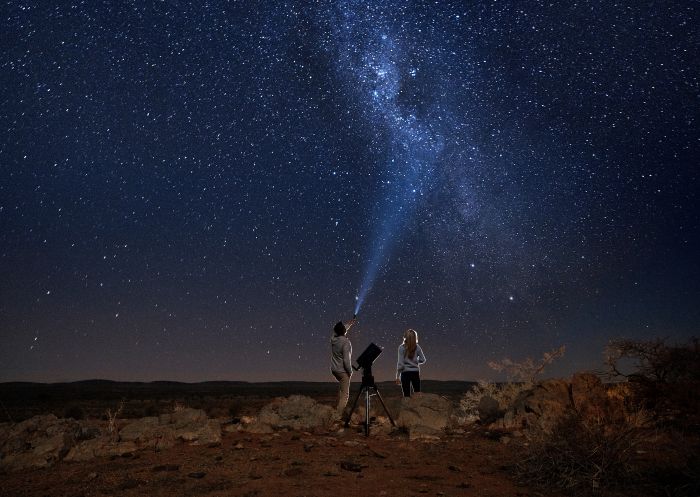
Outback Astronomy, Broken Hill
Coonabarabran
Coonabarabran in NSW’s Warrumbungle region is known as the capital of Australian astronomy – and there’s good reason why. The region has zero light pollution and it’s home to the nation’s first Dark Sky Park – an honour bestowed by the International Dark-Sky Association. Warrumbungle National Park’s two observatories make it a magnet for professional and amateur astronomers. At Siding Spring Observatory, discover Australia’s largest optical telescopes, including the world-famous Anglo-Australian Telescope, which has a 3.9 metre-diameter mirror. Beyond the Sky Stargazing offers day tours of the telescope if you want an up-close look. Meanwhile, at Milroy Observatory, join research astronomer Donna on a kid-friendly tour discovering the Southern Hemisphere's night skies. Join Coonabarabran Stargazing to learn about the stories and history of the Milky Way. You can also simply set up your own telescope in one of Warrumbungle’s campsites.

Siding Spring Observatory, Coonabarabran - Credit: Filippo Rivetti
Blue Mountains
It will come as no surprise to discover that the Blue Mountains, just west of Sydney, is a perfect place to stare at the heavens. This is nature at its finest, with few lights and little outside distraction to disrupt your observations. Book a tour with Blue Mountains Stargazing, hosted by astronomer Dr Dimitri Douchin or one of his fellow guides, to see rings, moons and planets up close thanks to a state-of-the-art telescope. For an indulgent evening out, opt for their wine tasting experience where you'll see galaxies with a glass of vino in hand at Dryridge Estate. Creatives will enjoy the astrophotography workshop, which covers both the theory and practice of capturing the night sky.
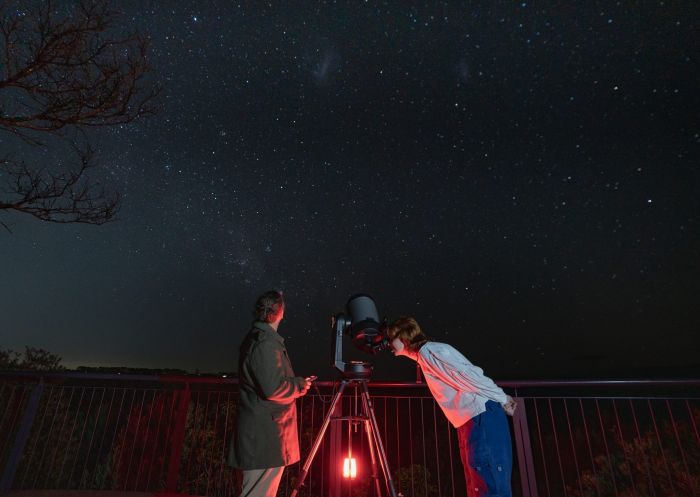
Blue Mountains Stargazing, Blue Mountains
Mudgee
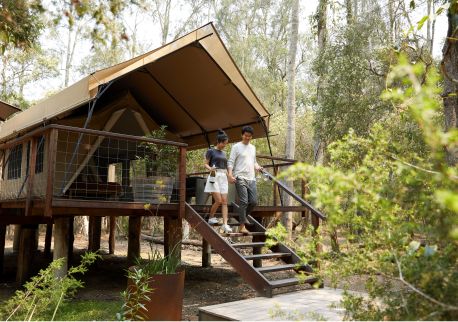
Hidden away in the hills outside Mudgee in the state’s Central West, in a spot with very little light pollution, Mudgee Observatory is a private institution that accepts guests and group tours. Astronomer and owner John Vetter guides visitors through the visible constellations – which are seasonal – via four telescope domes that provide incredible views out into space, where something that once seemed black-and-white is suddenly visible in colour as you zoom in close to planets and stars. The theatre and planetarium run several features on the night sky and sun, as well as programs on space missions. Glamp outside the city lights at Sierra Escape to enjoy the night sky in all its glory.
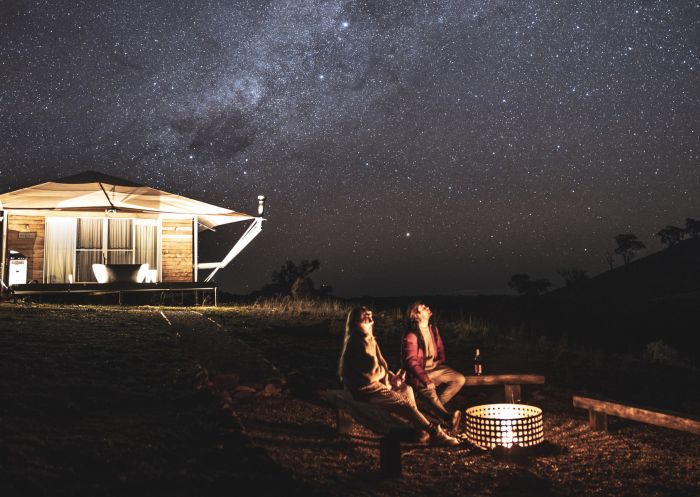
Sierra Escape, Piambong - Credit: Guy Williment
Parkes
Few observatories in the world can claim the historical significance that Parkes enjoys. Communications from the Apollo 11 moon landing were received and relayed here, while cult film The Dish, whose story is based on those events, was also set and shot here. Visit the Parkes Observatory and, of course, you’ll get to see that dish – the 64m wide antenna operates 24 hours a day and is still used, among other things, to detect signs of alien life. You’ll also have a chance to explore the interactive displays and the 3D theatre on site. While stargazing experiences aren't offered, it's a must-see for anyone fascinated by astronomy.

Parkes Observatory, Parkes
Dubbo
Located just behind Dubbo's Taronga Western Plains Zoo, Dubbo Observatory has several powerful telescopes to view the night sky, including a 20-inch telescope. There are group solar-viewing shows during the day and stargazing sessions at night. You can also book an astrophotography session where you can capture images of deep-sky objects through a telescope using your own camera.

Dubbo Observatory, Dubbo
Sydney
Great news: you don’t even have to leave the confines of Sydney to enjoy an eye-opening stargazing adventure. Occupying a heritage-listed sandstone building in The Rocks, on the appropriately named Observatory Hill, Sydney Observatory has played a pivotal role in Australia’s astronomical history, and continues to offer memorable experiences to visitors. During the day, use the telescope to view the sun, the moon and even Venus. At night, let expert guides lead you through the basics of celestial navigation, while also viewing some of the dark-sky highlights through the telescope. Night photography workshops are offered monthly.
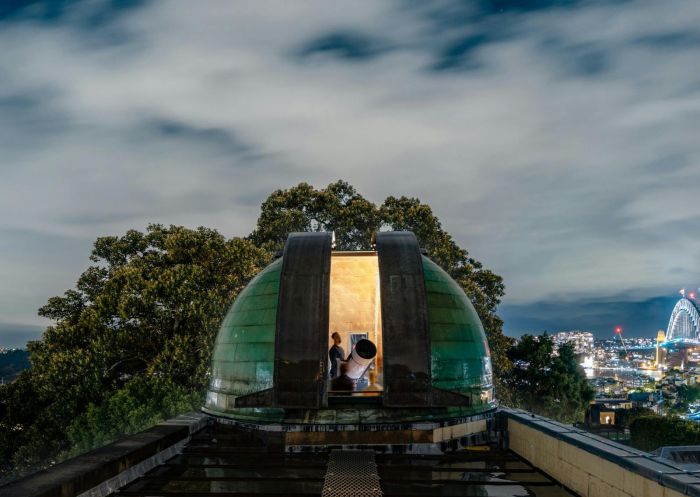
Sydney Observatory, Sydney - Credit: Demas Rusli
On the northern fringe of Sydney, you'll find the first Urban Night Sky Place in Australia and the Southern Hemisphere at Palm Beach Headland. Covering 62 hectares across Governor Phillip Park (open at any time for members of the public to view the night sky) and Barrenjoey Headland (closed from dusk to dawn and only open for approved DarkSky events), you can enjoy oceanside views of the starry night sky here.

Barrenjoey Lighthouse, Palm Beach
Byron Bay
Byron Bay’s sparkly shores are certainly a drawcard for day-trippers, but the evening sky is just as glorious due to its low light pollution – especially if you’re willing to drive a little inland. Byron Bay Stargazing offers stargazing camps led by astrophysicist Dr Dimitri Douchin, with cosy tents pitched under a blanket of constellations and state-of-the-art telescopes provided. If you’ve splurged on your trip and booked a villa at the chic Elements of Byron, then you’re in luck. In-house guests can book an intimate stargazing session steps away from the beachfront resort and connect with the cosmos.

Byron Bay Stargazing Camps, Byron Bay - Credit: Blue Mountains Stargazing
Jervis Bay
While the beautiful beaches in Jervis Bay make for a lovely place to swim, they’re also a great spot to stargaze. Jervis Bay Stargazing offers magical tours right at the water’s edge with an expert guide decoding the stars and pointing out antique constellations and star signs, alongside sightings of Saturn, Jupiter, Mars, Venus and the Orion Nebula. The 90-minute experience also features a Q&A with an astronomer and a complimentary digital night photo. While you’re there, keep your eyes out for neon-blue bioluminescence along the shore.

Jervis Bay Stargazing, Jervis Bay - Credit: Rob King
FAQs
What time of year is best for stargazing in NSW?
What time of year is best for stargazing in NSW?
The best time of year for stargazing in NSW is winter when the nights are longer, the air is drier and there’s less humidity. The centre of the Milky Way is also more visible in the colder months. To improve your chances, head out on a new or crescent moon.
Where are the best places for stargazing near Sydney?
Where are the best places for stargazing near Sydney?
The best stargazing experiences near Sydney include Sydney Observatory in The Rocks and Palm Beach Headland Urban Night Sky Place on the northern fringe of Sydney.
Which observatories can you visit in NSW?
Which observatories can you visit in NSW?
There are plenty of observatories for stargazing worth visiting for in NSW including:


