














Yaamanga (around here)


Product List
Product List
Overview
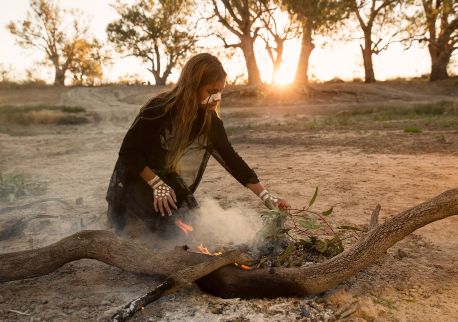
Yaamanga (around here) is an ongoing exhibition exploring the history and identity of the Coffs Coast through themes of place, community and belonging, with Gumbaynggirr culture at its heart.
A key highlight of Yaamanga (around here) is the short film, Daalga Nginundi Wajaarr (Sing Your Country), which is informed by Yuludarla's (Gumbaynggirr Creator) journey from north to south exploring miirlarl (sacred places), culture and history through…
Yaamanga (around here) is an ongoing exhibition exploring the history and identity of the Coffs Coast through themes of place, community and belonging, with Gumbaynggirr culture at its heart.
A key highlight of Yaamanga (around here) is the short film, Daalga Nginundi Wajaarr (Sing Your Country), which is informed by Yuludarla's (Gumbaynggirr Creator) journey from north to south exploring miirlarl (sacred places), culture and history through song and cinema. The piece is a celebration of language and its revival and is an invitation for all people to learn the story of this place. It explores untold histories of Country; its triumphs and its sorrow and the dialogue Gumbaynggirr people have every day with her.
Daalga Nginundi Wajaarr (Sing Your Country) was created by Alison Page and Nik Lachajczak of ZAKPAGE. The score is a reworking of a medley of traditional songs by Gumbaynggirr artist, Birrugan Dunn-Velasco, with the inclusion of post-modern instrumentation and sounds from Country.
This artwork is dedicated to the Gumbaynggirr people; it is their ancestral lands upon which we live and work; they who are so generous with their cultural knowledge and lore in the making of this film.
Get in touch
Product List
More Like This
Product List
Location
FAQs
Accessibility
A quiet space is available at the venue/ facility
Actively welcomes people with access needs.
Advise tour guides of the access needs of guests at the time of booking (includes pick up and drop off requirements)
Caters for people who are blind or have vision loss
Caters for people who are deaf or have hearing loss
Caters for people who use a wheelchair.
Caters for people with allergies and intolerances.
Caters for people with sufficient mobility to climb a few steps but who would benefit from fixtures to aid balance. (This includes people using walking frames and mobility aids)
Employ people with disability
Have a hearing loop
Have a step free main entrance to the building and/or reception area (includes ramps or slopes with a maximum gradient of 1:14, otherwise are too steep for wheelchairs)
Have a wheelchair accessible toilet / shower and change room
Have accessibility information and photos, including of a bathroom, room and/or floor plan on your website (can be emailed on request)
Have an accessible public toilet which is unlocked
Have audio enabled lifts
Have doorways which are easy to open and have lever handles (doorways 850mm or wider when open and not heavy)
Have Exit signs which are visible at a ground level (high level signs are difficult to see in a fire)
Have grab rails in the bathroom
Have handrails on all your stairways
Have lifts with enough space for people using a mobility aid to enter and turn around to use the lift buttons. Buttons are at accessible height.
Have raised tactile buttons in your lifts
Have step free access to the conference or function room
Have step free outdoor pathways (includes picnic areas, barbecues and shelters)
Have visual alerts for emergencies (Include flashing light)
Modify your cooking and cleaning practices to cater for people with food allergies or chemical intolerances (could include menus with meals free from: nuts, dairy, seafood, eggs, gluten etc)
Offer a range of contact methods for receiving complaints
Offer multiple options for booking - web, email, phone
Provide assistance with booking arrangements (includes providing clear itineraries with written instructions on what to do at various destinations)
Provide digital communication materials (hard copy information is also available on line)
Provide information in audio format (includes an audio described map of your venue, audio descs of performances and/ or displays)
Provide information in large print
Provide seating in common areas including reception area
Train your staff in customer service for people with vision loss (training would incorporate way finding and communicating with people with vision loss)
Train your staff in communicating with people who are deaf or have hearing loss
Train your staff in communicating with people with learning or behavioural challenges
Train your staff in disability awareness
Use easy read fonts in your signage and communication materials (Helvetica and Arial)
Use floors/coverings which are slip resistant, firm and smooth
Use non-slip tiles in the bathroom or slip resistant matting
Use Plain English / easy read signage and information (includes menus and emergency information)
Website meets WCAG 2.0 accessibility standards
Welcomes and assists people who have challenges with learning, communication, understanding and behaviour. (includes people with autism, intellectual disability, Down syndrome, acquired brain injury (ABI), dyslexia and dementia)