














Yaamanga (ungefähr hier)


Product List
Product List
Überblick
„Yaamanga“ (Hier und jetzt) ist eine fortlaufende Ausstellung, die die Geschichte und Identität der Coffs Coast anhand der Themen Ort, Gemeinschaft und Zugehörigkeit erforscht und dabei die Kultur der Gumbaynggirr in den Mittelpunkt stellt.
Ein Höhepunkt von „Yaamanga“ (Hier und jetzt) ist der Kurzfilm „Daalga Nginundi Wajaarr“ (Singt euer Land). Er basiert auf der Reise von Yuludarla (der Schöpferin der Gumbaynggirr) von Norden nach Süden, auf…
„Yaamanga“ (Hier und jetzt) ist eine fortlaufende Ausstellung, die die Geschichte und Identität der Coffs Coast anhand der Themen Ort, Gemeinschaft und Zugehörigkeit erforscht und dabei die Kultur der Gumbaynggirr in den Mittelpunkt stellt.
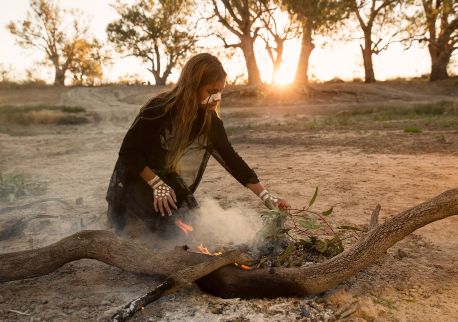
Ein Höhepunkt von „Yaamanga“ (Hier und jetzt) ist der Kurzfilm „Daalga Nginundi Wajaarr“ (Singt euer Land). Er basiert auf der Reise von Yuludarla (der Schöpferin der Gumbaynggirr) von Norden nach Süden, auf der sie durch Gesang und Film die heiligen Stätten (miirlarl), die Kultur und die Geschichte des Landes erkundet. Der Film ist eine Hommage an die Sprache und ihre Wiederbelebung und lädt alle Menschen ein, die Geschichte dieses Ortes kennenzulernen. Er beleuchtet die bisher unerzählten Geschichten des Landes, seine Triumphe und sein Leid sowie den Dialog, den die Gumbaynggirr täglich mit ihm führen.
„Daalga Nginundi Wajaarr“ (Singt euer Land) wurde von Alison Page und Nik Lachajczak von ZAKPAGE geschaffen. Die Filmmusik ist eine Bearbeitung eines Medleys traditioneller Lieder der Gumbaynggirr-Künstlerin Birrugan Dunn-Velasco, angereichert mit postmodernen Instrumenten und Klängen der Country-Musik.
Dieses Kunstwerk ist dem Volk der Gumbaynggirr gewidmet; es ist ihr angestammtes Land, auf dem wir leben und arbeiten; sie haben so großzügig ihr kulturelles Wissen und ihre Überlieferungen für die Entstehung dieses Films zur Verfügung gestellt.
Kontaktieren Sie uns
Product List
Ähnliche Artikel
Product List
Standort
FAQs
Zugänglichkeit
A quiet space is available at the venue/ facility
Actively welcomes people with access needs.
Advise tour guides of the access needs of guests at the time of booking (includes pick up and drop off requirements)
Geeignet für blinde oder sehbehinderte Menschen
Geeignet für Menschen mit Hörbehinderung oder Taubheitsgefühl.
Geeignet für Rollstuhlfahrer.
Caters for people with allergies and intolerances.
Geeignet für Personen, die zwar einige Stufen steigen können, aber von Haltegriffen profitieren würden. (Dies schließt Personen ein, die Gehhilfen und Mobilitätshilfen benutzen.)
Employ people with disability
Have a hearing loop
Have a step free main entrance to the building and/or reception area (includes ramps or slopes with a maximum gradient of 1:14, otherwise are too steep for wheelchairs)
Have a wheelchair accessible toilet / shower and change room
Have accessibility information and photos, including of a bathroom, room and/or floor plan on your website (can be emailed on request)
Have an accessible public toilet which is unlocked
Aufzüge mit Audiofunktion
Die Türen sollten sich leicht öffnen lassen und über Hebelgriffe verfügen (Türen sollten im geöffneten Zustand mindestens 850 mm breit und nicht schwer sein).
Have Exit signs which are visible at a ground level (high level signs are difficult to see in a fire)
Have grab rails in the bathroom
Have handrails on all your stairways
Die Aufzüge sollten so gestaltet sein, dass Personen mit Mobilitätshilfen problemlos einsteigen und sich umdrehen können, um die Aufzugsknöpfe zu bedienen. Die Knöpfe müssen in barrierefreier Höhe angebracht sein.
Installieren Sie erhabene taktile Tasten in Ihren Aufzügen.
Have step free access to the conference or function room
Have step free outdoor pathways (includes picnic areas, barbecues and shelters)
Have visual alerts for emergencies (Include flashing light)
Modify your cooking and cleaning practices to cater for people with food allergies or chemical intolerances (could include menus with meals free from: nuts, dairy, seafood, eggs, gluten etc)
Offer a range of contact methods for receiving complaints
Offer multiple options for booking - web, email, phone
Provide assistance with booking arrangements (includes providing clear itineraries with written instructions on what to do at various destinations)
Provide digital communication materials (hard copy information is also available on line)
Provide information in audio format (includes an audio described map of your venue, audio descs of performances and/ or displays)
Informationen in Großdruck bereitstellen
Provide seating in common areas including reception area
Train your staff in customer service for people with vision loss (training would incorporate way finding and communicating with people with vision loss)
Train your staff in communicating with people who are deaf or have hearing loss
Train your staff in communicating with people with learning or behavioural challenges
Train your staff in disability awareness
Use easy read fonts in your signage and communication materials (Helvetica and Arial)
Use floors/coverings which are slip resistant, firm and smooth
Use non-slip tiles in the bathroom or slip resistant matting
Use Plain English / easy read signage and information (includes menus and emergency information)
Website meets WCAG 2.0 accessibility standards
Welcomes and assists people who have challenges with learning, communication, understanding and behaviour. (includes people with autism, intellectual disability, Down syndrome, acquired brain injury (ABI), dyslexia and dementia)