
















Baajim Debut Solo Exhibition
Sat 05 Dec '26

Product List
Product List
Overview
Baajim is magic in Gumbaynggirr language, and this powerful new exhibition by Gumbaynggirr artist Lilly Clegg celebrates the beauty of nature and explores a sense of knowing that there is far more happening in this world than what meets the eye. Lilly is a visual artist, weaver, sculptor, ceramicist and cultural educator whose creative practice is grounded in nature and connection, and her vibrant inaugural solo exhibition reflects this journey…
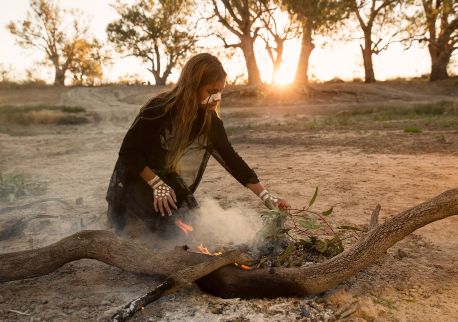
Baajim is magic in Gumbaynggirr language, and this powerful new exhibition by Gumbaynggirr artist Lilly Clegg celebrates the beauty of nature and explores a sense of knowing that there is far more happening in this world than what meets the eye. Lilly is a visual artist, weaver, sculptor, ceramicist and cultural educator whose creative practice is grounded in nature and connection, and her vibrant inaugural solo exhibition reflects this journey of exploration in its diversity. After a youth spent between her mother's mob in the Clarence Valley and a commune in Mullumbimby, Lillys' contemporary art practice has developed into a psychedelic translation of cultural experience, rich with mystical and astrological symbology.
Through Baajim, you are invited to experience a world shaped by ancestral wisdom, creativity, and connection. Each artwork carries layers of meaning, a celebration of identity, Country and the living spirit of Gumbaynggirr culture. Baajim is more than an exhibition; it is an invitation to connect, learn and experience the magic and mystery of an unseen world.
The exhibition will open at Wadjar Regional Indigenous Gallery. Refreshments provided. Please RSVP via Facebook, Humanitix or the website for catering purposes.
Thanks to Create NSW for supporting public programs.
Get in touch
Location
Yarrawarra Aboriginal Cultural Centre
69 Red Rock Road Corindi Beach NSW 2456 Australia
Get directionsFAQs
Accessibility
A quiet space is available at the venue/ facility
Actively welcomes people with access needs.
Adhere to The Food Authority requirements for allergy management in food preparation
Advise tour guides of the access needs of guests at the time of booking (includes pick up and drop off requirements)
Ask all visitors if there are any specific needs to be met
Caters for people who are blind or have vision loss
Caters for people who are deaf or have hearing loss
Caters for people who use a wheelchair.
Caters for people with allergies and intolerances.
Caters for people with high support needs who travel with a support person
Have a low noise reception areas with hearing loss friendly acoustics and adequate lighting for viewing facial expressions (includes common areas which are free of background noise, background music)
Have a place to store medical equipment (eg oxygen)
Have a step free main entrance to the building and/or reception area (includes ramps or slopes with a maximum gradient of 1:14, otherwise are too steep for wheelchairs)
Have a wheelchair accessible toilet / shower and change room
Have accessible seating areas in theatrette
Have an accessible public toilet which is unlocked
Have at least one wheelchair accessible parking space with wheelchair accessible signage clearly displayed (International standards are 3200mm wide x 2500 mm high)
Have equipment to respond to anaphylactic shock such as epi–pens and defibrillator
Have Exit signs which are visible at a ground level (high level signs are difficult to see in a fire)
Have handrails on all your stairways
Have rooms which are interconnecting
Have step free access to restaurant, lounge and bar
Have step free access to the conference or function room
Have step free outdoor pathways (includes picnic areas, barbecues and shelters)
Have twin beds available on request
Modify your cooking and cleaning practices to cater for people with food allergies or chemical intolerances (could include menus with meals free from: nuts, dairy, seafood, eggs, gluten etc)
Offer a range of contact methods for receiving complaints
Offer multiple options for booking - web, email, phone
Provide digital communication materials (hard copy information is also available on line)
Provide information in large print
Train your staff in communicating with people who are deaf or have hearing loss
Train your staff in communicating with people with learning or behavioural challenges
Train your staff to respond to allergic reactions
Use easy read fonts in your signage and communication materials (Helvetica and Arial)
Use Plain English / easy read signage and information (includes menus and emergency information)
Welcomes and assists people who have challenges with learning, communication, understanding and behaviour. (includes people with autism, intellectual disability, Down syndrome, acquired brain injury (ABI), dyslexia and dementia)