











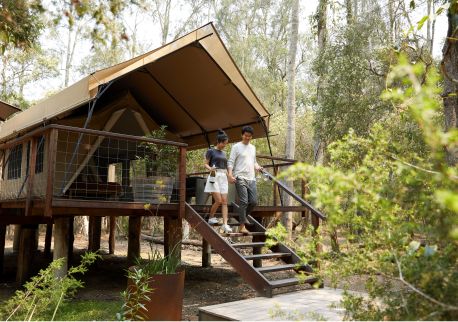


The Retreat at Froog Moore Park


Product List
Product List
Highlights
- Five uniquely styled luxury suites for ultimate comfort and privacy.
- Gourmet breakfast and intimate in-house dining for a romantic experience.
- Prime location just 2 minutes from Tamworth's vibrant cafés and attractions.
Overview
Experience an unforgettable romantic getaway at our luxury boutique hotel, where every detail is designed to inspire, enchant, and relax.
Choose from five individually styled luxury suites, each offering its own distinctive atmosphere. From the tribal elegance of the Henderson Room to the expansive Succulent Suite with its private veranda and soaring breakfast space, every suite offers refined comfort and privacy. The Japanese-inspired Maeda…
Experience an unforgettable romantic getaway at our luxury boutique hotel, where every detail is designed to inspire, enchant, and relax.
Choose from five individually styled luxury suites, each offering its own distinctive atmosphere. From the tribal elegance of the Henderson Room to the expansive Succulent Suite with its private veranda and soaring breakfast space, every suite offers refined comfort and privacy. The Japanese-inspired Maeda Room provides tranquil sophistication, while the exotic Moroccan Fantasy Suite captivates with opulent décor and a statement claw-foot bath. For couples seeking something bold and intimate, The Dungeon surrounds you in sensual tones and ambient mood lighting — perfect for a romantic escape or honeymoon accommodation.
Guests can indulge in a gourmet breakfast each morning, prepared to satisfy every taste. In the evening, enjoy in-house dining crafted with passion and served in our glittering gallery — an intimate setting ideal for couples celebrating a special occasion, anniversary, or luxury weekend retreat.
The Retreat offers a serene couples sanctuary to unwind and reconnect. And when you're ready to explore, their boutique accommodation is ideally located just two minutes from the Tamworth central business district, placing you within easy reach of vibrant cafés, fine dining, and local attractions.
Whether you're planning a honeymoon, anniversary celebration, or romantic weekend in Tamworth, their luxury boutique hotel offers an indulgent and unforgettable escape.
Get in touch
Location
FAQs
Accessibility
A quiet space is available at the venue/ facility
Actively welcomes people with access needs.
Adhere to The Food Authority requirements for allergy management in food preparation
Allow space around toilet for a wheelchair (A space of at least 900mm width beside the toilet pan and 1200mm clearance in front of the toilet pan is required)
Ask all visitors if there are any specific needs to be met
Caters for people who are blind or have vision loss
Caters for people who are deaf or have hearing loss
Caters for people who use a wheelchair.
Caters for people with allergies and intolerances.
Caters for people with sufficient mobility to climb a few steps but who would benefit from fixtures to aid balance. (This includes people using walking frames and mobility aids)
Have a doorbell or intercom at an accessible height and display a contact number (accessible height is 900mm-1100 mm)
Have a handheld shower hose (should be at least 1500mm long)
Have a lever handle on bathroom door
Have a lever handle on the door (easier to use)
Have a shower curtain (no door)
Have a step free main entrance to the building and/or reception area (includes ramps or slopes with a maximum gradient of 1:14, otherwise are too steep for wheelchairs)
Have a wheelchair accessible bathroom (Entrance to bathroom must have step free greater than 5mm or a doorway threshold ramp not exceeding 1:8 for 450mm. Bathrooms dimensions must be no less than 2000mm X 2500mm. Have a hobless (step free) shower recess. Shower recess must have at least 1100 x 1100mm clear area for wheelchair access (no door). Have a slip resistant fold down seat or fixed seat in shower .Seat must be at least 900mm long.)
Have a wheelchair accessible toilet / shower and change room
Have accessibility information and photos, including of a bathroom, room and/or floor plan on your website (can be emailed on request)
Have an appropriate area for toileting an assistance dog
Have at least one wheelchair accessible parking space with wheelchair accessible signage clearly displayed (International standards are 3200mm wide x 2500 mm high)
Have doorways which are easy to open and have lever handles (doorways 850mm or wider when open and not heavy)
Have enough space for a wheelchair to move around three sides of a double king sized bed (A pathway of 1200mm minimum width is required for wheelchair access)
Have grab rails in the bathroom
Have grabrails in shower recess (can be removable and height adjustable)
Have handrails on all your stairways
Have step free access to restaurant, lounge and bar
Have step free access to room (Entrance to the room wheelchair accessible with step free greater than 5mm or has a doorway threshold ramp not exceeding 1:8 for 450mm length)
Have step free access to the conference or function room
Have step free outdoor pathways (includes picnic areas, barbecues and shelters)
Have TVs with captioning option
Modify your cooking and cleaning practices to cater for people with food allergies or chemical intolerances (could include menus with meals free from: nuts, dairy, seafood, eggs, gluten etc)
Offer a range of contact methods for receiving complaints
Offer multiple options for booking - web, email, phone
Provide a bed with adjustable height
Provide assistance with booking arrangements (includes providing clear itineraries with written instructions on what to do at various destinations)
Provide grabrails provided adjacent to the toilet
Provide seating in common areas including reception area
Train your staff in customer service for people with vision loss (training would incorporate way finding and communicating with people with vision loss)
Train your staff in communicating with people who are deaf or have hearing loss
Train your staff in communicating with people with learning or behavioural challenges
Train your staff in disability awareness
Train your staff to respond to allergic reactions
Use easy read fonts in your signage and communication materials (Helvetica and Arial)
Use floors/coverings which are slip resistant, firm and smooth
Use non-slip tiles in the bathroom or slip resistant matting
Use Plain English / easy read signage and information (includes menus and emergency information)
Welcomes and assists people who have challenges with learning, communication, understanding and behaviour. (includes people with autism, intellectual disability, Down syndrome, acquired brain injury (ABI), dyslexia and dementia)